
I’ll be part of a panel discussing danceroom Spectroscopy at the SxSW interactive festival in Austin, Texas on 13th Mar. Giddyup! details of when and where can be found here.
danceroom Spectroscopy has its own site
danceroom Spectroscopy (dS) continues to pick up momentum beyond what I ever imagined – just this week, we have been covered in Chemistry World and on The Creators Project. With all this coverage, and given our coming appearances at South by Southwest festival, the Bristol Harbourside Festival, and as part of the London 2012 cultural Olympiad, my own site is becoming pretty dS heavy.
So we’ve launched a new site, which will serve as the official vehicle for dS content on the web. The URL is http://danceroom-spec.com/ Enjoy! and spread the word!
quantum biology and Ockham’s razor
On a microscopic scale, nearly all the machinery that keeps your cells working involves chemical reactions of some sort. Lots of these reactions wouldn’t happen without a helping hand. At the molecular nano-scale, nature’s helping hands are called enzymes, and they’ve sparked plenty of recent controversy amongst biophysicists (see, e.g., this or that).
One sticky issue concerns the interrelationship between enzyme motion and quantum phenomena – in particular quantum tunnelling. It’s been known for some time that a whole host of reactions across a range of chemistry and biology involve quantum tunnelling, and scientists have developed accurate models to describe it. However, a number of experimental observations have led to recent suggestions that quantum tunnelling models for chemical reactions are inadequate when enzymes are involved. A corollary of this proposal is that enzymes may somehow be modifying tunneling – and that we therefore require new models for understanding how enzymes work.

Simple schematic of a two-dimensional energy landscape
In a Nature Chemistry paper posted today, myself, J.N. Harvey, and A.J. Mulholland took Ockham’s razor to the enzyme tunneling problem. Contrary to previous proposals, we use some simple math to show that standard models for describing quantum tunneling can explain the experimental enzyme data, so long as one accounts for the fact that enzymes have multidimensional energy landscapes. This feature of biochemical systems has been highlighted for some time by folks who study protein folding – and our paper suggests that related models do alright for enzymes too.
Arnolfini public talk
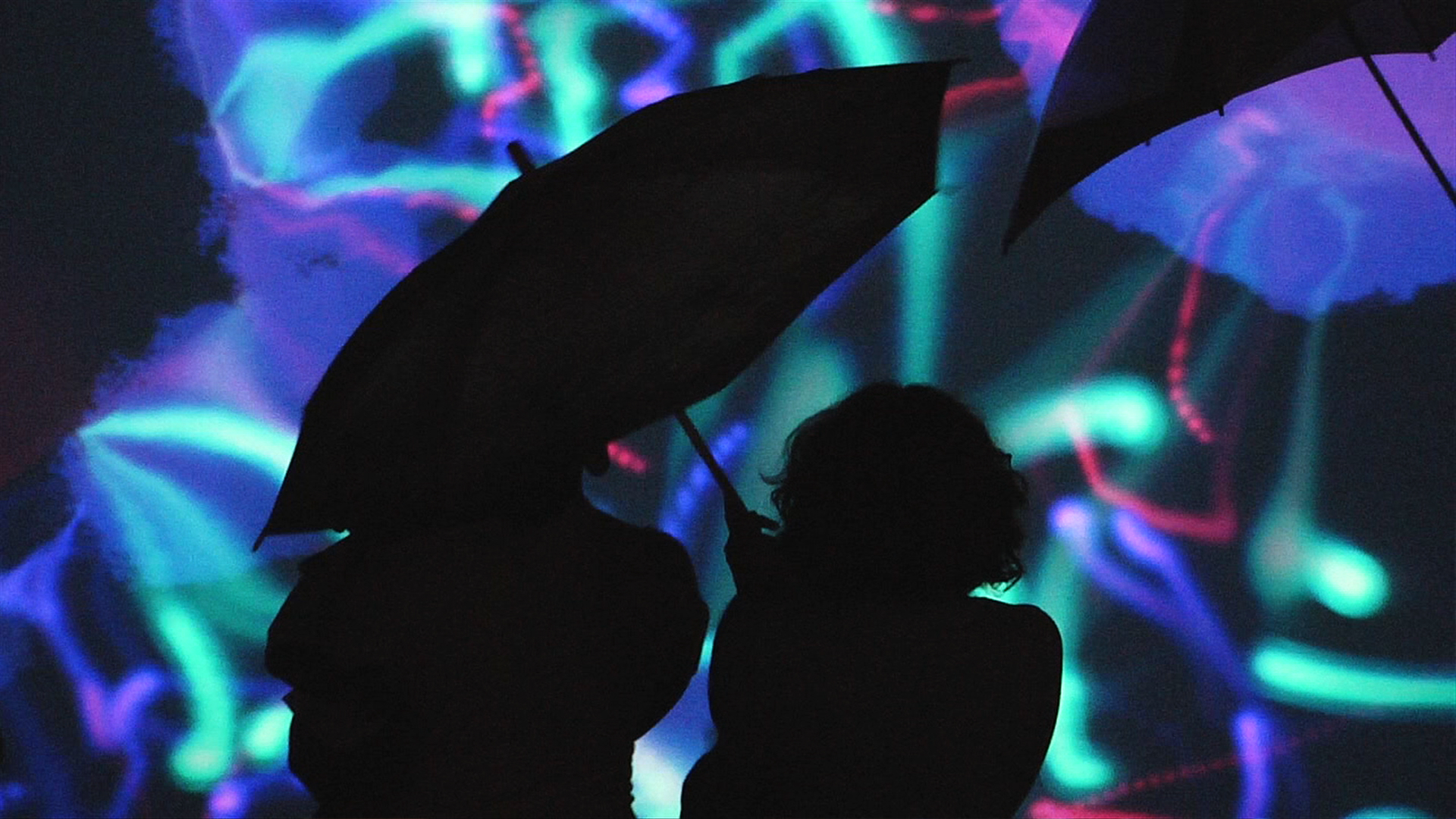 On Friday 9th December, I gave a public presentation at the Arnolfini (Bristol) about the danceroom spectroscopy project – describing what it’s about, what we’ve done, and where it might go. Click here to look at my my slides, here for links to the video clips I showed, and here for a radio interview I gave (starts at 42 mins, ~4/5 the way through).
Physics World Danceroom Spectroscopy feature…
Click here for a link to a Physics World feature about Danceroom Spectroscopy…
Mapping ultrafast energy flow in liquids
 Chemistry is about breaking and making chemical bonds. On a microscopic level, breaking a chemical bond requires that a large quantity of energy is first localized in that particular bond. Similarly, making a chemical bond places lots of energy into a particular bond. Most chemical reactions take place with reactant molecules embedded in a sea of unreactive liquid (or solvent) molecules. Common solvents, including water and organic liquids, play an important role in both shuffling energy to reacting molecules, and subsequently shuffling it away after reaction has occurred. However, when chemists think about reactions in liquids, they tend to overlook the underlying energy shuffle that transports energy to and from the chemical reaction. Instead, they focus on the equilibrium states that occur well before, and well after, a reaction occurs, which are well described by a theoretical paradigm based on linear response theory and the fluctuation-dissipation theorem.
Continue reading
COMET meeting, Oxford
From 11th-16th September, I attended the 2011 Conference On Molecular Energy Transfer (COMET), and gave an oral presentation. The meeting programme featured a number of memorable talks from well-known scientists like Gerard Meijer, Arthur Suits, Alec Wodtke, John Tully, Dick Zare, Kopin Liu, Rienk van Grondelle, Fleming Crim, Dan Neumark, Paul Corkum, Jun Ye, and Ed Hinds. The presentations spanned a range disciplines across chemical physics including cold molecule chemistry, surface dynamics, ultrafast biochemistry, condensed phase chemistry, and interfacial dynamics.
TEDx Bristol talk
On 8th September, I gave a talk about our science-meets-art project, danceroom spectroscopy, at a TEDx event in Bristol (where x = independently organized) that was held at the MShed. Mine was the concluding talk of the day. Feedback was excellent. Further details, including videos and photos, can be found here.
Spectroscopy at Shambala Festival
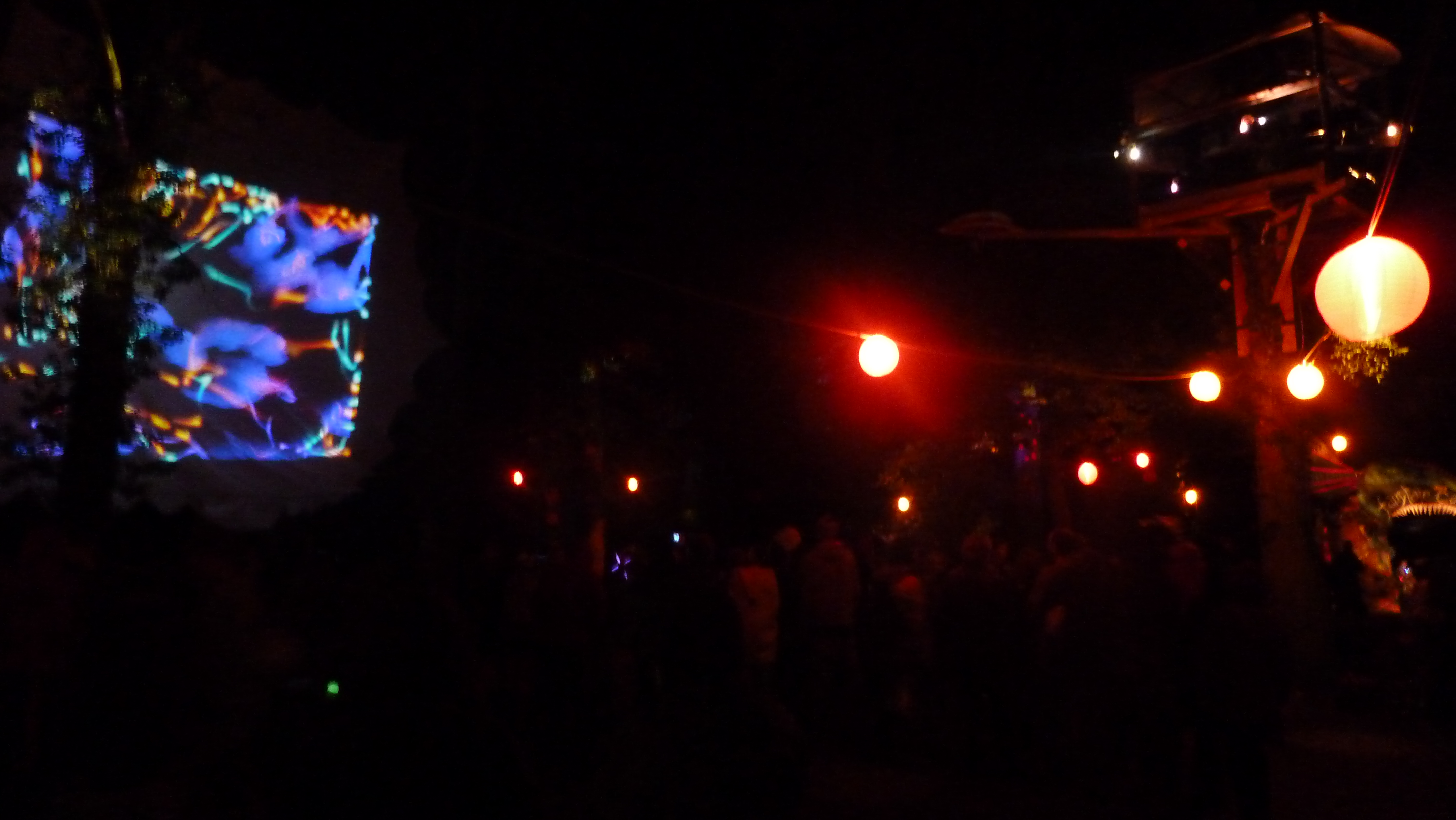
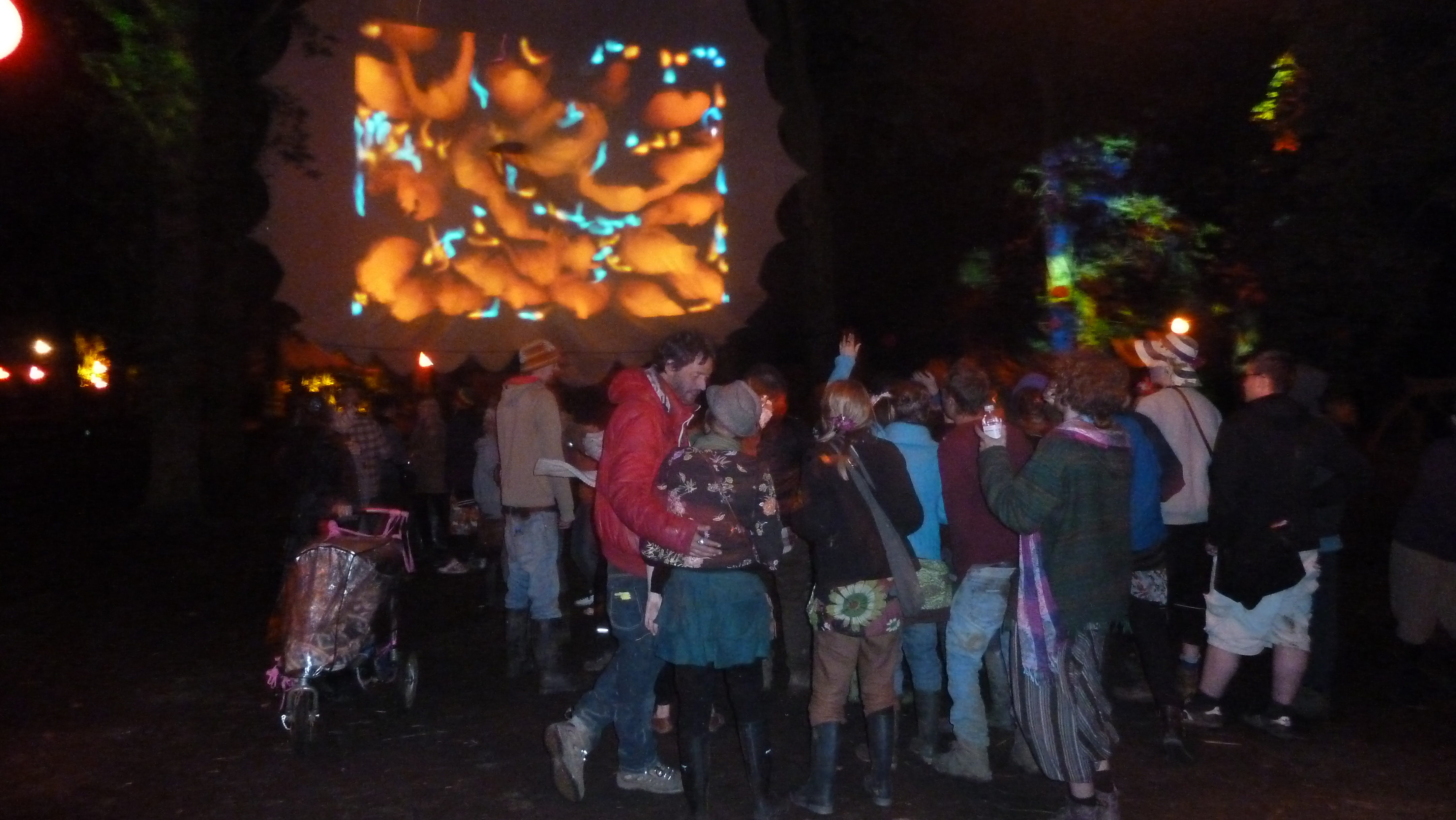 On 27th and 28th August, we did Spectroscopy at the Shambala Festival. We projected onto a massive 11 m diameter screen suspended between two large trees. Our mission control was up in a treehouse! You can download a *.zip file of photos here.
Arnolfini Exhibition Footage
Footage from our recent exhibition at the Arnolfini (Bristol). There’s also some photos that you can see here, and a very interesting article about one man’s dS experience.
 David Glowacki