
On 6 august, I gave a short description of danceroom spectroscopy for BBC radio Bristol on the Saturday breakfast show. You can listen to it here – my interview is the last one before the show ends – at 2:57:00 elapsed time… unfortunately, the recording cuts out at 3:00:00! (it didnt cut out live)
Scientific Meetings in Madison & Chicago
Over the past few weeks, I was in the US. From July 15-17, I participated in the CHARMM meeting, which is organized by Martin Karplus. I gave a talk about recent contributions that I have made to the CHARMM biophysics simulation package. I also visited colleagues in the chemical dynamics section at Argonne National Labs and in Fleming Crim’s group at UW-Madison. During both of these visits, I gave talks about solution phase chemical dynamics.
New Spectroscopy Footage
Check out some unedited clips from our recent danceroom spectroscopy workshops.
Spectroscopy in Barcelona & Bristol
 Danceroom Spectroscopy is gonna be doing stuff in the next few months. We’re gonna be featured in Barcelona as part of the SONAR fringe. Then, we’ll be conducting some workshops with professional dancers and other experts in highly evolved forms of human movement at Bristol’s best-known contemporary art museum, the Arnolfini. Finally, it will culminate in a large (free!) public exhibition at the Arnolfini on 7 August, where they’re gonna let us rig their auditorium so that you can literally step into and interact with a visuals and sounds generated by quantum particle dynamics. Spread the word…
The physics of photosynthetic light harvesting
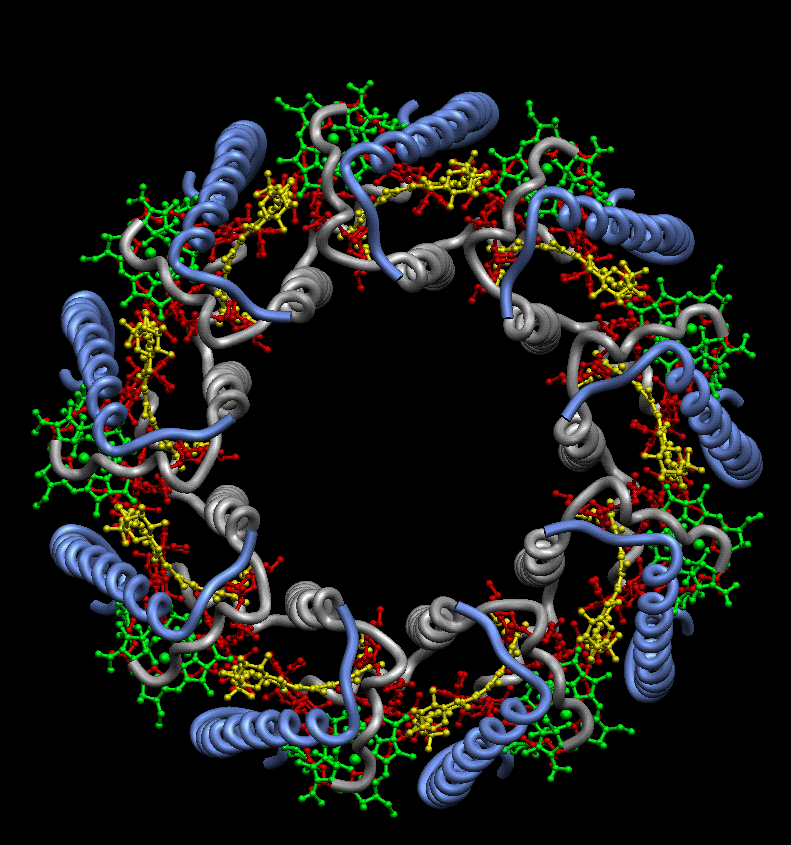
structure of light harvesting complex II membrane protein
On May 27-28 at the Kavli Royal Society Centre, I attended a stimulating conference on the microphysics and evolutionary adaptations that have resulted in the ability of plants and photobacteria to harvest energy from the sun. A corresponding focus of this area of research is on what aeons of natural evolution might teach humans as we attempt to engineer nano-materials to address our own planetary energy needs in an increasingly post-carbon economy. Chemical physicists who gave talks and with whom I had previous familiarity included Graham Fleming (UC Berkeley) and Greg Scholes (Toronto). And there were a number of other talks from biologists and materials physicists, including Seth Lloyd (MIT) and Richard Cogdell (Glasgow)… a recent review in Science touches on many of the issues in this fascinating and important research arena.
Another video – DanceRoom Spectroscopy Project Trailer
Here’s a video containing a description/footage of DanceRoom Spectroscopy.
And here’s a link to some tracks mixed at Changing Perspectives by Lee J. Malcolm using the DanceRoom Spectroscopy code (ToddlerSteps-MovingOn & ToddlerSteps). Click to play, or right click to download… More to come!
The Sights & Sounds of Danceroom Spectroscopy
Check out this video of some of the sights and sounds generated by DanceRoom Spectroscopy. The people that you see in the video are interactively warping the virtual force field felt by an ensemble of 70 particles in a mixed classical-quantum Feynmann-Hibbs simulation. The sounds that you hear in the video are generated on-the-fly via analysis of particle-particle collision events which were recorded at Changing Perspectives over 18th-19th March…
DanceRoom Spectroscopy v0.1 was a big hit!!
 On 18th-19th March, we rolled out v0.1 of DanceRoom Spectroscopy at the University of Bristol Changing Perspectives event. And it was a big hit! On the order of 800 – 1000 people experienced it, and everyone – kids, grannies, moms, dads, hippies, artists, scientists, and anarchists – were into it! We’re in the process of confirming exhibitions that will be held at the Arnolfini, a well-known Bristol contemporary art museum, in July and August. Stay tuned. For more info, check out the Arts tab of my site. We’ve also set up a Danceroom Spectroscopy Facebook page which will keep you abreast of what we’re doing with it and where you might see it…
Quantum Specificity in Liquid Phase Chemistry
 I’ve recently been involved in a collaboration with members of the Bristol laser group. They used ultrafast infrared lasers to watch real-time product formation for a chemical reaction occurring in a liquid. Their time resolution was on the order of picosecsonds (10-12 seconds), which allowed them to watch reaction products being produced in an excited vibrational quantum state. I was able to rationalize their experiments by showing that the gas and liquid phase reaction free energy profiles are more similar than had previously been supposed. Thus, at very short times – on the order of ~10 picoseconds – the reaction in a liquid proceeds more or less identically to what happens in a low pressure gas. This work has been funded by the EPSRC, and is featured on the cover of the 18th March issue of Science, with follow-up publications to appear shortly. Click here to view some movies of how the reaction proceeds in both a gas and a liquid.
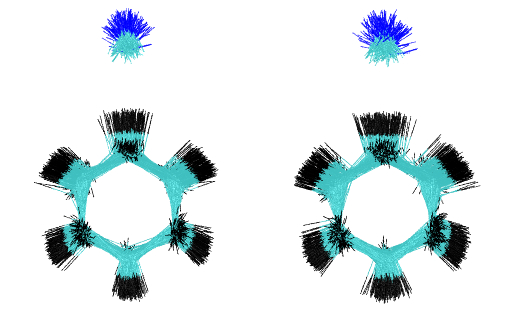
The left and right hand graphics show overlays of the CN + cyclohexane geometries at the point where they pass over their respective transition states in a gas and in a liquid (dichloromethane). Their similarity explains in part, why at short times, the gas phase quantum state specificity carries over to liquids.
Pervasive Media Studio Residency
I have taken up a New Talent residency at the Pervasive Media Studio to work on the recently funded Danceroom Spectroscopy Project, which was mentioned in the Watershed news – in the context of a remarks about the 3d film industry, and alongside a picture of Avatar!

