
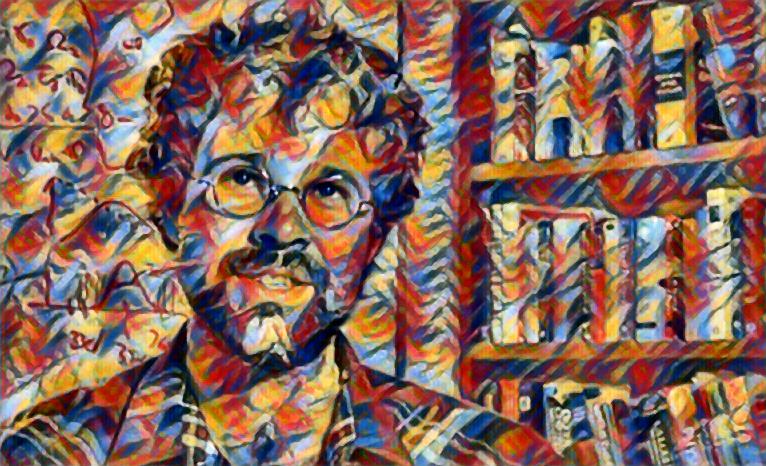
David Glowacki (that’s me) is originally from Milwaukee. I am a cross-disciplinary researcher, artist, author, and activist with interests spanning computer science, nanoscience, aesthetics, cultural theory, & spirituality. I have done a lot of work in VR applied to interactive scientific simulation and visualisation. I founded a research group called the ‘Intangible Realities Laboratory’ (IRL) who carry out open source research and software development at the immersive frontiers of scientific, aesthetic, computational, and technological practice. The IRL’s headquarters are in Santiago de Compostela in Northern Spain at the CiTIUS Intelligent Technologies Research Centre.
I earned my undergraduate degree at UPenn, where I had the opportunity to study a range of subjects, including chemistry, mathematics, philosophy, comparative literature, and religions. After that, I obtained an MA in cultural theory as a Fulbright finalist at the University of Manchester (UK). I then completed a PhD in molecular physics at Leeds University (UK). Over the years, I have received various awards to support the IRL’s research activities , including a Royal Society Research Fellowship, Philip Leverhulme award, ERC grant, and others.
As an artist, the immersive computational artworks I’ve worked on over the years have been experienced by more than 200,000 people on three continents, installed at a number of well-known cultural and media venues across Europe, the USA, and Asia, including the Barbican Arts Centre (London), the ZKM | Center for Art and Media Technology (Karlsruhe, Germany), the London Olympics (London, UK), the Stanford University Art Institute (Palo Alto, California), the Bhutan International Festival (Thimphu, Bhutan), and others. Digital aesthetics isn’t the only art form I explore; sometimes I design altogether different types of performance art experiments…
I have published across several domains, including non-equilibrium molecular physics, classical & quantum dynamics, computational biochemistry, human-computer interaction, high-performance computing, computer graphics, evolutionary algorithms, machine learning & data science, digital aesthetics, interactive computational art, religion & power, cultural theory, optics, and scientific instrument development.
I’m interested in how aesthetics relate to scientific imagination. This is particularly important in domains which cannot be seen with the naked eye, where scientific intuition is guided by the aesthetic representations and metaphors we use to imagine phenomena which are otherwise invisible. I would go so far to claim that imagery is the reality in these domains, profoundly impacting how we communicate these ‘realities’, in both research & educational contexts. Over the last several years, the IRL’s work in computational aesthetics – i.e., to make artworks – has opened up new scientific research horizons, research paradigm where aesthetic enquiry and scientific enquiry are locked in mutual dialogue, each pushing one another into new territories.
I’m also interested in the overlap between the aesthetics of quantum realities described by scientists and the aesthetics of spiritual realities described by mystics, both of which offer lenses for visualizing matter’s essential nature as energy. This aesthetic paradigm has proven incredibly useful in helping us to develop immersive digital experiences which enable people to reimagine their essential nature as energy. With support from the Tiny Blue Dot Foundation, we are currently developing these ideas to create experiences which help people reimagine their essential nature as energy, and which can be offered to those recently diagnosed with life threatening illness – e.g., cancer – as a way to alleviate the fear and anxiety that often accompanies such diagnoses.
 David Glowacki
I wanna get hydrated man….
“Irritated by the distraction, audience members proceeded to physically eject the Bristol University academic from the area, in what Mr Morris claims is the first such incident at a classical concert since the 18th century.”
YOU ARE A GOD AMONGST MEN