
The last couple weeks have been lots of fun! With support from the Leverhulme Trust, the Royal Society, Arts Council England, and the EPSRC CHAMPS programme, I’ve been working on a project called “Figuring” at the Wickham theatre in the University of Bristol’s Department of Drama, with a talented team drawn across artistic, scientific, and technological practices. On 21 Sept, we showed Figuring to an audience of artists, producers, and technologists. This follows on from a previous showings of Figuring, for example at the Knowle West Media Centre, as part of their Commons Sense programme.
Continue reading
Author Archives: David R Glowacki
VR Enabled real-time simulation: NYT, Nature, BBC
Really excited to report that the open access Science Advances paper published by O’Connor et al. during the summer, entitled “Sampling molecular conformations and dynamics in a multiuser virtual reality framework” has since generated significant media exposure, having been picked up by a number of scientific media outlets. Nature, the New York Times, and the BBC’s “Science in Action” show (the VR piece begins 7 mins in) all contacted me in order to discuss the implications this work could have for nanotech research. It’s been exciting to witness the interest which the paper has generated. It certainly seems to be captivating people’s imaginations, and is attracting lots of attention by workers across academia & industry.
The Intangible Realities Laboratory


Given how many times I’ve walked into the lab and seen this kind of thing going on, ‘Intangible Realities Laboratory’ definitely seems appropriate. And now that we have a shiny brass plaque, the IRL is official.
Science Advances virtual reality paper

Working with academic colleagues from high-performance computing (HPC) and human-computer interaction (HCI), we recently published an open access paper entitled “Sampling molecular conformations and dynamics in a multiuser virtual reality framework” in the AAAS journal Science Advances. The paper described a scientifically rigorous, VR-enabled, multi-person, real-time interactive Molecular Dynamics (iMD) framework, which lets researchers use virtual reality to literally reach out & touch real-time molecular physics using cloud-mounted supercomputing.
Continue reading
interactive MD art installation

In collaboration with Bristol-based tech startup Interactive Scientific, more than 37,000 people had the chance to experience the acclaimed real-time interactive molecular dynamics art installation ‘danceroom Spectroscopy’ (dS) at the ‘We the Curious’ science museum in central Bristol.
Continue reading
molecular graphics & modelling society award
 Good news! I was recently informed that I’ve been selected as the recipient of the 10th “Silver Jubilee” award from the molecular graphics and modelling society (MGMS), which aims to recognize contributions to the field of molecular modelling and related areas. As part of this prize, I will be invited to give a series of prize lectures. Further details to follow.
Chemistry World Feature
 Chemistry World, published by the Royal Society of Chemistry, has run a little feature outlining research progress we’ve been making as we explore real-time molecular simulation in virtual reality. The article tagline is brilliant: “Gaming-style tech is putting the fun into fundamental molecular simulations”. I love that. You can look at the article here.
OpenWorld San Francisco
During the first week of October, I attended the Oracle Open World conference in San Francisco, where I was invited to give a talk entitled “Collaborative Cloud-Based Virtual Reality for Scientific Research & Education”.
Continue reading
modern art oxford: future knowledge

photo courtesy of Stu Allsopp

photo courtesy of Stu Allsopp

photo courtesy of Stu Allsopp

photo courtesy of Stu Allsopp

photo courtesy of Stu Allsopp

photo courtesy of Stu Allsopp

photo courtesy of Stu Allsopp

photo courtesy of Stu Allsopp

photo courtesy of Stu Allsopp

photo courtesy of Stu Allsopp

photo courtesy of Stu Allsopp

photo courtesy of Stu Allsopp

photo courtesy of Stu Allsopp

photo courtesy of Stu Allsopp

photo courtesy of Stu Allsopp
On 17th June, Lisa May Thomas and I led a workshop at Modern Art Oxford entitled “Sculpting the Invisible World”. The work was part of the gallery’s ‘Future Knowledge’ program of events, curated by Emma Ridgway, and photographed by Stu Allsop. Using a pioneering multi-person virtual reality software framework, visitors were invited to interact within a virtual landscape as embodied energy fields. Methods from rigorous computational molecular physics and real-time digital rendering allowed digitally embodied participants to sculpt the dynamics of a simulated molecular nano-world, for example deforming buckminsterfullerene molecules, passing them back and forth, threading methane molecules through a carbon nanotube, and tying knots in proteins.
Continue reading
Photosynthetic excitation energy transport
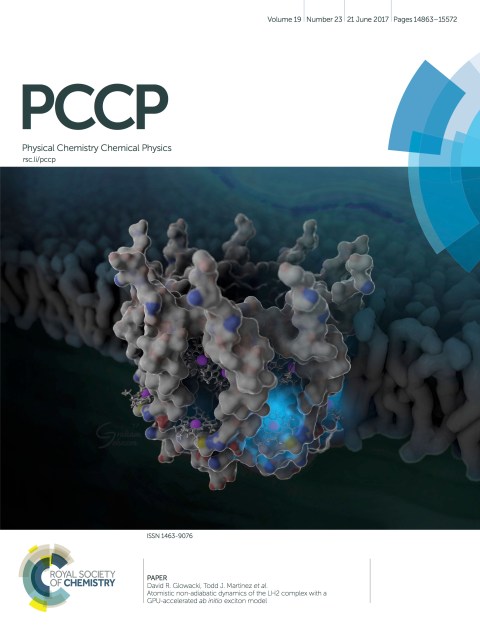
Another paper to report on (open-access link available here). This work examines excitation energy transport in LH2, a supramolecular photosynthetic complex which is found in the cell membranes of purple bacteria. Lots of people have gotten interested in LH2 ever since Graham Fleming’s group published a paper in 2007 reporting on fancy 2d spectroscopy which observed coherent quantum “beating” between initially prepared electronic states. Beating patterns of this sort are certainly of fundamental interest, and the experiments used to observe it were very nice; however, the consensus which seems to be emerging is that the “beating” is in fact not so important for explaining the efficiency at which photosynthetic systems transport electronic energy across their membranes.
 David Glowacki